Current Location: Home : Firearms : Juuhoukata Chap. 2-4
Chapter 2: Terminology
The Action of Firing
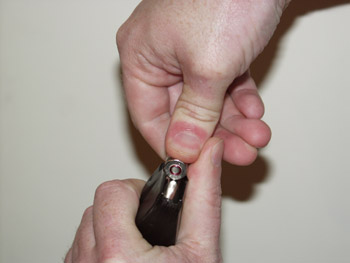
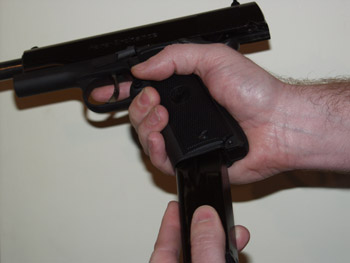
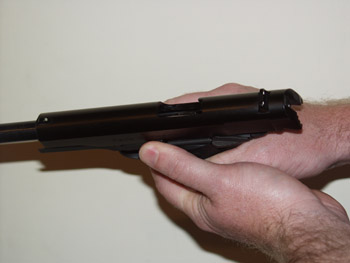
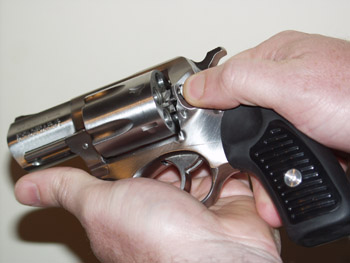
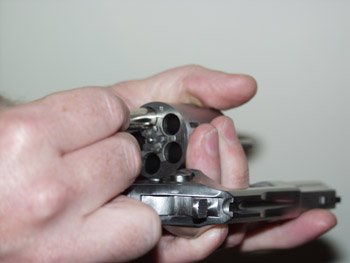
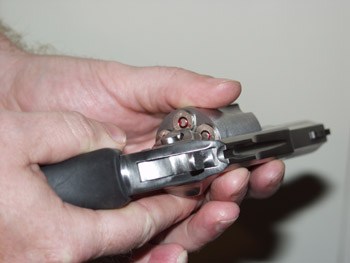
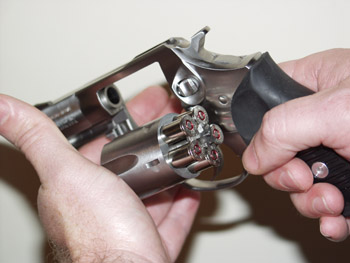
For a firearm to function, it must be loaded and cocked. Loading a revolver involves releasing the crane and swinging the cylinder out, then placing fresh cartridges into the cylinder chambers and re-latching the cylinder in place. Loading an automatic involves placing ammunition into the magazine by depressing the follower with the cartridge and pushing it under the lips of the magazine. The magazine is then inserted into the grip of the handgun until it locks securely in place. The slide is drawn fully backwards, exposing the first cartridge in the magazine, and then released. The slide spring pulls the slide closed. The face of the slide pushes on the head of the first cartridge and pushes it from under the lips and into the breech. A ramp is usally machined into the breech to facilitate the cartridges' passage. The small rebated rim of the cartridge slides under the extractor's hook as the cartridge moves into position.
There are two types of actions on handguns, referring to the steps required to cock the gun. Single action guns require that the hammer be pulled back into the cock the gun. In revolvers, this is done manually with the thumb. In semi-automatic pistols, this is usually done when the slide is drawn back. The hammer stays back until the trigger is depressed.
Single action means that each pull of the trigger performs a single action- namely, dropping the hammer.
Double action guns move the hammer back each time the trigger is pulled.
In other words, each pull of the trigger performs two actions- cocking the gun by moving the hammer back, and releasing the hammer once the trigger is at its full travel.
Most all modern revolvers are double action; only very early models or replica guns are single action. Most semi-automatic pistols based on the Colt 1911A1 design are single action guns. Most modern semi-automatic pistols are double/single action, meaning that the first shot is a double action one; every shot after that until the pistol is decocked are single action.
Single action only guns, like the Colt 1911 and the Glock, require very little pressure on the trigger to fire them. This allows for accurate shots, because you don't have to press hard and possibly jerk the gun off target. However, it also decreases the safety margin in having a harder trigger pull; and if you practice proper trigger control, the harder pull shouldn't matter. Double action only guns are fairly rare. Modern revolvers are usually fired double action, unless the time is taken to cock the gun manually before each shot. This is why revolvers generally do not have manual safeties; with 10-14 pounds of pressure required to fire the gun double action, there is little chance of accidentally triggering it provided the gun is handled correctly. Single action only semi-automatic pistols such as the Colt 1911 are either carried decocked, in which case they must be manually cocked before firing; or "cocked and locked"; that is, carried with the hammer back and the safety on. This seems inherently dangerous, but if proper gun safety rules are followed, is no more dangerous than any other method of carry. Glocks, while single action only, have a unique "trigger safety" that allows them to be carried cocked safely. (Glock would have you call this Safe-Action rather than Single-Action to set their guns apart from others. While it is an innovative mechanism,
I personally still consider it single action.) Double/single guns, like
most third generation Smith & Wessons, take some getting used to; but
offer the best of both worlds. They may be carried loaded with the hammer
down and the safety off; only the first shot will require a harder trigger
pull. Subsequent shots, until the hammer is manually dropped on an empty
chamer or decocked, will be the easy-pull single action.
The firing sequence for a revolver is simple. When you squeeze the trigger
or cock the hammer back, a pawl rotates the cylinder until a new round
is rotated into position. When you finish the trigger pull, the sear releases
the hammer, which is driven forward under spring pressure to strike the
firing pin. The firing pin strikes the primer, firing the round.
Semi-autos go through a bit more complex process. Starting with a full
magazine in the gun and the slide back, when you release the slide it snaps
forward; pushing a fresh round forward from under the magazine feed lips.
A feed ramp on the barrel guides the round into the chamber, and the magazine
follower pushes up on the next round. When you squeeze the trigger, the
sear releases the hammer to strike the firing pin; which then strikes the
primer, firing the round. Since every action has an opposite and equal
reaction, the force that pushes the bullet out of the barrel also pushes
back on the slide, forcing it back once again. The now empty brass case
is pulled back with the slide by the extractor, and the edge of the case
strikes the ejector; flipping it out of the gun. The slide is now back
far enough to push the next round into the chamber and start the cycle
over again. If the magazine is empty, a lip on the follower pushes up on
the slide release lever and locks the slide in the back position.
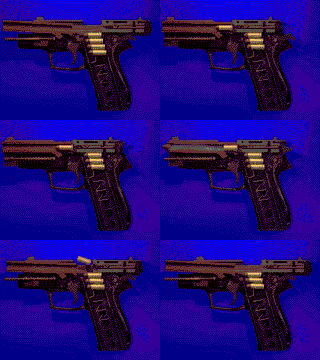 |
Animation of semi-auto firing process.
A better Flash animation can be found at
this website.
(animation courtesy SafetyOn, LLC
©)
|
Whew! That's a lot to swallow in one sitting. If you've never heard these terms before, take some time to review them and the illustrations so you're familiar with them; as they'll be used quite a bit from here on out. The next section deals with what happens in the split second after you carefully squeeze the trigger to fire the gun.
Previous : TOC : Next