Current Location: Home : Firearms : Juuhoukata Chap. 2-5
Chapter 2: Terminology
Interior Ballistics
Ballistics deals with the flight of a projectile through a space. With regards to firearms, it's divided into three classifications: interior, exterior, and terminal. Terminal ballistics refers to the actions of the projectile after it has reached its target. External ballistics deals with the flight of the bullet after it has left the barrel but before it hits the target. Internal ballistics deals with the bullet while it's still in the barrel.
When you squeeze the trigger and the hammer falls forward to strike the firing pin, several things happen within microseconds. The firing pin strikes the primer, crushing it and causing the small amount of very sensative explosive inside to detonate. The flame from this explosion passes through the flash hole in the case and ignites the powder charge.
The powder itself, contrary to popular belief, does not explode. Rather, it burns; albeit very quickly. As it burns, it produces many times its own volume of gas. This expanding gas produces a lot of pressure inside the case; the pressure forces the bullet out of the case and into the barrel.
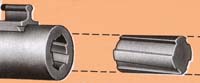 The barrel of a rifled firearm is grooved. The inside of the barrel is actually cut away during the manufacturing process in a series of spiral grooves. The remaining material is called a land. The projectile is about the same diameter as the grooves; the caliber of a weapon is defined as the diameter of the barrel measured between two lands. A .22 caliber is .22 inches in diameter; a 9mm is 9mm in diameter, etc. When the bullet is forced into the barrel by the expanding gasses, the lands cut into the surface of the projectile. The bullet follows the rifling around in a spiral as it travels down the barrel. This spin is necessary to stabilize the bullet in flight, much the same way as a football is stabilized by spinning it as it's thrown.
The projectile accellerates down the length of the barrel, with the gasses right behind it. The instant it leaves the muzzle, it stops accellerating, and the exterior ballistics phase takes over. The gasses emerge from the muzzle in a cloud of surprisingly little smoke, some flame depending on the barrel size and type of ammunition, and a loud bang.
However, the laws of physics dictate that this is not the only motion present. For every action there is a reaction, and guns are no exception. The force of the gas pushing the bullet out of the barrel is also pushing backwards against your hand. This is recoil, and will be discussed quite a bit later on. In revolvers, this recoil is wasted force. In semi-automatic pistols, it's necessary to operate the gun. The recoil forces the slide backwards, letting it pull out the expended case with the extractor and kick it out with the ejector; uncovering the next round in the magazine and (except for double-action only guns) pushing the hammer back to cock the gun once again. The slide is pulled back forwards by the slide spring, pushing a new round out of the magazine and into the breech, beginning the cycle once again. Knowing this sequence is important to shooting a semi-automatic pistol, as you will see later on.
Previous : TOC : Next